|
|
| (同じ利用者による、間の4版が非表示) |
| 1行目: |
1行目: |
| {| class="wikitable" style="width:80%"
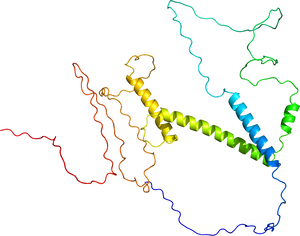
| | [[ファイル:Q7RTS3.pdb|サムネイル|'''図2. ヒトPTF1A立体構造'''<br>AlphaFold予測(Q7RTS3)]] |
| |+ 内因性オピオイドペプチドとその受容体
| |
| |-
| |
| ! scope="col" | オピオイドペプチド
| |
| ! scope="col" | [[アミノ酸配列]]
| |
| ! scope="col" | [[オピオイド受容体]] 標的
| |
| ! scope="col" | <small>参考文献</small>
| |
| |-
| |
| ! scope="col" colspan="1" | [[エンケファリン]]
| |
| ! scope="col" colspan="3" |
| |
| |-
| |
| | [[ロイ-エンケファリン]] || YGGFL || [[δ-オピオイド受容体]]<sup>†</sup>、[[μ-オピオイド受容体]]<sup>†</sup> || <ref name="Endogenous opioid families - 2012 review">{{cite journal | vauthors = Li Y, Lefever MR, Muthu D, Bidlack JM, Bilsky EJ, Polt R | title = Opioid glycopeptide analgesics derived from endogenous enkephalins and endorphins | journal = [[Future Medicinal Chemistry]] | volume = 4 | issue = 2 | pages = 205–226 | date = February 2012 | pmid = 22300099 | pmc = 3306179 | doi = 10.4155/fmc.11.195 | postscript = ,}} in particular [https://www.ncbi.nlm.nih.gov/pmc/articles/PMC3306179/table/T1/ Table 1: Endogenous opioid peptides].</ref><ref name="IUPHAR Opioid receptors - Introduction">{{cite web | title=Opioid receptors: Introduction | url=http://www.guidetopharmacology.org/GRAC/FamilyIntroductionForward?familyId=50 | work= IUPHAR/BPS Guide to PHARMACOLOGY | publisher=International Union of Basic and Clinical Pharmacology | vauthors = Toll L, Caló G, Cox BM, Chavkin C, Christie MJ, Civelli O, Connor M, Devi LA, Evans C, Henderson G, Höllt V, Kieffer B, Kitchen I, Kreek MJ, Liu-Chen LY, Meunier JC, Portoghese PS, Shippenberg TS, Simon EJ, Traynor JR, Ueda H, Wong YH | access-date = 20 October 2017 | date=10 August 2015 }}</ref><ref name="IUPHAR - δ-opioid receptor" />
| |
| |-
| |
| | [[メチオニン-エンケファリン]] || YGGFM || [[δ-オピオイド受容体]]<sup>†</sup>、[[μ-オピオイド受容体]]<sup>†</sup> || <ref name="Endogenous opioid families - 2012 review" /><ref name="IUPHAR Opioid receptors - Introduction" /><ref name="IUPHAR - δ-opioid receptor" />
| |
| |-
| |
| | [[メトルファミド]] || YGGFMRRV-NH<sub>2</sub> || [[δ-オピオイド受容体]]、[[μ-オピオイド受容体]] || <ref name="Endogenous opioid families - 2012 review" />
| |
| |-
| |
| | [[ペプチドE]] || YGGFMRRVGRPEWWMDYQKRYGGFL || [[μ-オピオイド受容体]]、[[κ-オピオイド受容体]] || <ref name="Endogenous opioid families - 2012 review" />
| |
| |-
| |
| ! scope="col" colspan="1" | [[エンドルフィン]]
| |
| ! scope="col" colspan="3" |
| |
| |-
| |
| | [[α-エンドルフィン]] || YGGFMTSEKSQTPLVT || [[μ-オピオイド受容体]]、他のオピオイド受容体への親和性は不明 || <ref name="Endogenous opioid families - 2012 review" />
| |
| |-
| |
| | [[β-エンドルフィン]] || YGGFMTSEKSQTPLVTLFKNAIIKNAYKKGE || [[μ-オピオイド受容体]]<sup>†‡</sup>、[[δ-オピオイド受容体]]<sup>†</sup> || <ref name="Endogenous opioid families - 2012 review" /><ref name="IUPHAR Opioid receptors - Introduction" /><ref name="IUPHAR - δ-opioid receptor">{{cite web | title=δ receptor|url=http://www.guidetopharmacology.org/GRAC/ObjectDisplayForward?objectId=317 | work= IUPHAR/BPS Guide to PHARMACOLOGY | publisher=International Union of Basic and Clinical Pharmacology | access-date= 28 December 2017 | date=15 May 2017 | quote = Principal endogenous agonists (Human) [are]<br />β-endorphin (POMC, P01189), [Leu]enkephalin (PENK, P01210), [Met]enkephalin (PENK, P01210)}}</ref><ref name="IUPHAR - μ-opioid receptor">{{cite web | title=μ receptor|url=http://www.guidetopharmacology.org/GRAC/ObjectDisplayForward?objectId=319 | work= IUPHAR/BPS Guide to PHARMACOLOGY | publisher=International Union of Basic and Clinical Pharmacology | access-date= 28 December 2017 | date=15 March 2017 | quote = Comments: β-Endorphin is the highest potency endogenous ligand ...<br />Morphine occurs endogenously ([[#Poeaknapo|Poeaknapo et. al. 2004]]) ...<br />Principal endogenous agonists (Human) [are]<br />β-endorphin (POMC, P01189), [Met]enkephalin (PENK, P01210), [Leu]enkephalin (PENK, P01210)}}, citing:
| |
| * {{cite journal | vauthors = Poeaknapo C, Schmidt J, Brandsch M, Dräger B, Zenk MH | year = 2004 | title = Endogenous formation of morphine in human cells | journal = Proc. Natl. Acad. Sci. USA | volume = 101 | issue = 39 | pages = 14091–6 | doi = 10.1073/pnas.0405430101 | doi-access = free | pmc = 521124 | pmid = 15383669 | bibcode = 2004PNAS..10114091P | ref = Poeaknapo}}
| |
| </ref>
| |
| |-
| |
| | [[γ-エンドルフィン]] || YGGFMTSEKSQTPLVTL || [[μ-オピオイド受容体]]、他のオピオイド受容体への親和性は不明 || <ref name="Endogenous opioid families - 2012 review" />
| |
| |-
| |
| ! scope="col" colspan="1" | [[ダイノルフィン]]
| |
| ! scope="col" colspan="3" |
| |
| |-
| |
| | [[ダイノルフィンA]] || YGGFLRRIRPKLKWDNQ || [[κ-オピオイド受容体]]<sup>†‡</sup> || <ref name="Endogenous opioid families - 2012 review" /><ref name="IUPHAR Opioid receptors - Introduction" /><ref name="IUPHAR - κ-opioid receptor" />
| |
| |-
| |
| | [[ダイノルフィンA<sub>1–8</sub>]] || YGGFLRRI || [[κ-オピオイド受容体]]、[[μ-オピオイド受容体]]([[δ-オピオイド受容体]]に対して部分アゴニスト) || <ref name="HMDB Dynorphin A 1-8">{{cite encyclopedia | title=Dynorphin A 1–8 | url=http://www.hmdb.ca/metabolites/HMDB0012933 | encyclopedia=HMDB Version 4.0 | publisher=Human Metabolome Database | access-date=20 October 2017 | date=27 September 2017 | quote = Dynorphin A (1–8) is a fraction of Dynorphin A with only Tyr-Gly-Gly-Phe-Leu-Arg-Arg-Ile peptide chain.}}</ref><ref name="IUPHAR - Dynorphin A-(1-8) - Biological activity">{{cite web | title=Dynorphin A-(1–8): Biological activity | url=http://www.guidetopharmacology.org/GRAC/LigandDisplayForward?tab=biology&ligandId=1621 | work= IUPHAR/BPS Guide to PHARMACOLOGY | publisher=International Union of Basic and Clinical Pharmacology | access-date= 20 October 2017 }}</ref>
| |
| |-
| |
| | [[ダイノルフィンB]] || YGGFLRRQFKVVT || [[κ-オピオイド受容体]] || <ref name="Endogenous opioid families - 2012 review" /><ref name="IUPHAR Opioid receptors - Introduction" />
| |
| |-
| |
| | [[ビッグダイノルフィン]] || YGGFLRRIRPKLKWDNQKRYGGFLRRQFKVVT || [[κ-オピオイド受容体]]<sup>†‡</sup> || <ref name="IUPHAR - κ-opioid receptor">{{cite web | title=κ receptor|url=http://www.guidetopharmacology.org/GRAC/ObjectDisplayForward?objectId=318 | work= IUPHAR/BPS Guide to PHARMACOLOGY | publisher=International Union of Basic and Clinical Pharmacology | access-date= 28 December 2017 | date=21 February 2017 | quote = Comments: Dynorphin A and big dynorphin are the highest potency endogenous ligands ...<br />Principal endogenous agonists (Human) [are]<br />big dynorphin (PDYN, P01213), dynorphin A (PDYN, P01213)}}</ref><ref name="IUPHAR - Big dynorphin - Biological activity">{{cite web | title=Big dynorphin: Biological activity|url=http://www.guidetopharmacology.org/GRAC/LigandDisplayForward?tab=biology&ligandId=3669 | work= IUPHAR/BPS Guide to PHARMACOLOGY | publisher=International Union of Basic and Clinical Pharmacology | access-date= 20 October 2017 | quote = Principal endogenous agonists at κ receptor}}.</ref><ref name="IUPHAR - Big dynorphin - Structure">{{cite web | title=Big dynorphin: Structure – Peptide Sequence | url=http://www.guidetopharmacology.org/GRAC/LigandDisplayForward?tab=structure&ligandId=3669 | work= IUPHAR/BPS Guide to PHARMACOLOGY | publisher=International Union of Basic and Clinical Pharmacology | access-date= 20 October 2017 | quote = Peptide sequence<br />YGGFLRRIRPKLKWDNQKRYGGFLRRQFKVVT}}</ref>
| |
| |-
| |
| | [[リューモルフィン]] || YGGFLRRQFKVVTRSQEDPNAYYEELFDV || [[κ-オピオイド受容体]] || <ref name="Dynorphins 2009 review">{{cite journal | vauthors = Schwarzer C | title = 30 years of dynorphins—new insights on their functions in neuropsychiatric diseases | journal = Pharmacology & Therapeutics | volume = 123 | issue = 3 | pages = 353–370 | date = September 2009 | pmid = 19481570 | pmc = 2872771 | doi = 10.1016/j.pharmthera.2009.05.006 }}</ref><ref name="PubChem - Leumorphin">{{cite encyclopedia | title=Dynorphin B (1-29) | url = https://pubchem.ncbi.nlm.nih.gov/compound/16131065 | encyclopedia=PubChem Compound | publisher=United States National Library of Medicine – National Center for Biotechnology Information | access-date=28 December 2017 | date=23 December 2017}}</ref><ref name="Leumorphin primary 1">{{cite journal | vauthors = Suda M, Nakao K, Yoshimasa T, Sakamoto M, Morii N, Ikeda Y, Yanaihara C, Yanaihara N, Numa S, Imura H | title = Human leumorphin is a potent, kappa opioid receptor agonist | journal = Neuroscience Letters | volume = 50 | issue = 1–3 | pages = 49–52 | date = September 1984 | pmid = 6149506 | doi = 10.1016/0304-3940(84)90460-9 | s2cid = 42419724 }}</ref><ref name="Leumorphin primary 2">{{cite journal | vauthors = Inenaga K, Nagatomo T, Nakao K, Yanaihara N, Yamashita H | title = Kappa-selective agonists decrease postsynaptic potentials and calcium components of action potentials in the supraoptic nucleus of rat hypothalamus in vitro | journal = Neuroscience | volume = 58 | issue = 2 | pages = 331–340 | date = January 1994 | pmid = 7908725 | doi = 10.1016/0306-4522(94)90039-6| s2cid = 24631286 }}</ref>
| |
| |-
| |
| | [[α-ネオエンドルフィン]] || YGGFLRKYPK || [[κ-オピオイド受容体]] || <ref name="Endogenous opioid families - 2012 review" /><ref name="IUPHAR Opioid receptors - Introduction" />
| |
| |-
| |
| | [[β-ネオエンドルフィン]] || YGGFLRKYP || [[κ-オピオイド受容体]] || <ref name="Endogenous opioid families - 2012 review" />
| |
| |-
| |
| ! scope="col" colspan="1" | [[ノシセプチン]]
| |
| ! scope="col" colspan="3" |
| |
| |-
| |
| | [[ノシセプチン]] || FGGFTGARKSARKLANQ || [[ノシセプチン受容体]]<sup>†‡</sup> || <ref name="Endogenous opioid families - 2012 review" /><ref name="IUPHAR Opioid receptors - Introduction" /><ref name="IUPHAR - nociceptin receptor">{{cite web | title=NOP receptor|url=http://www.guidetopharmacology.org/GRAC/ObjectDisplayForward?objectId=320 | work= IUPHAR/BPS Guide to PHARMACOLOGY | publisher=International Union of Basic and Clinical Pharmacology | access-date= 28 December 2017 | date=18 August 2017 | quote = Natural/Endogenous Ligands<br />nociceptin/orphanin FQ}}</ref>
| |
| |-
| |
| ! scope="col" colspan="1" | [[エンドモルフィン]]
| |
| ! scope="col" colspan="3" |
| |
| |-
| |
| | [[エンドモルフィン-1]] || YPWF-NH<sub>2</sub> || [[μ-オピオイド受容体]] || <ref name="Endogenous opioid families - 2012 review" /><ref name="IUPHAR Opioid receptors - Introduction" />
| |
| |-
| |
| | [[エンドモルフィン-2]] || YPFF-NH<sub>2</sub> || [[μ-オピオイド受容体]] || <ref name="Endogenous opioid families - 2012 review" /><ref name="IUPHAR Opioid receptors - Introduction" />
| |
| |-
| |
| ! scope="col" colspan="4" style="text-align:left" | <sup>†</sup> この記号は、そのペプチドがヒトにおいて当該受容体の主要な内因性アゴニストであることを示す。<br /><sup>‡</sup> この記号は、そのペプチドがヒトにおいて当該受容体に対して最も高い既知の[[効力 (薬理学)|効力]]を持つ内因性リガンドであることを示す。
| |
| |}
| |