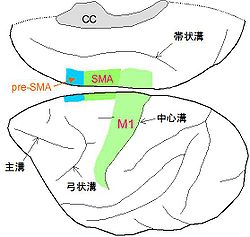
補足運動野(supplementary motor area, SMA)とは大脳皮質前頭葉のうちBrodmann分類の6野内側部を占める皮質運動領野である。Penfield, Welchによって初めてその存在が報告され、それまでに知られていた一次運動野に対して、もう一つの補足的な皮質運動領野であるという意味を込めて命名された。しかしその後の研究によって補足運動野は運動制御において一次運動野とは異なる固有の役割(例、自発的な運動の開始、異なる複数の運動を特定の順序に従って実行する、両手の協調動作など)を果たしていることが明らかにされている。なお、当初補足運動野は6野内側部全体を占めていると考えられていたが、現在では補足運動野は6野内側部後方を占める一方、6野内側部前方部は前補足運動野として区別される。このため、補足運動野は前補足運動野との区別を強調する意図でcaudal SMA, SMA properなどと呼ばれることもある。
↑W Penfield. K Welch The supplementary motor area of the cerebral cortex - A clinical and experimental study A.M.A. Archives of Neurology and Psychiatry 1951, 66(3):289-317
↑C Vogt. O Vogt Allgemeinere Ergebnisse unserer Hirnforschung Journal für Psychologie und Neurologie: 1919, 25:277-462
↑Matelli, M., Luppino, G., & Rizzolatti, G. (1991).
Architecture of superior and mesial area 6 and the adjacent cingulate cortex in the macaque monkey. The Journal of comparative neurology, 311(4), 445-62.
[PubMed:1757597]
[WorldCat]
[DOI]
↑Dum, R.P., & Strick, P.L. (1991).
The origin of corticospinal projections from the premotor areas in the frontal lobe. The Journal of neuroscience : the official journal of the Society for Neuroscience, 11(3), 667-89.
[PubMed:1705965]
[WorldCat]
↑Sakai, S.T., Inase, M., & Tanji, J. (1999).
Pallidal and cerebellar inputs to thalamocortical neurons projecting to the supplementary motor area in Macaca fuscata: a triple-labeling light microscopic study. Anatomy and embryology, 199(1), 9-19.
[PubMed:9924930]
[WorldCat]
[DOI]
↑Middleton, F.A., & Strick, P.L. (1997).
Dentate output channels: motor and cognitive components. Progress in brain research, 114, 553-66.
[PubMed:9193166]
[WorldCat]
[DOI]
↑Thaler, D., Chen, Y.C., Nixon, P.D., Stern, C.E., & Passingham, R.E. (1995).
The functions of the medial premotor cortex. I. Simple learned movements. Experimental brain research, 102(3), 445-60.
[PubMed:7737391]
[WorldCat]
[DOI]
↑Deecke, L., Kornhuber, H.H., Lang, W., Lang, M., & Schreiber, H. (1985).
Timing function of the frontal cortex in sequential motor and learning tasks. Human neurobiology, 4(3), 143-54.
[PubMed:4066425]
[WorldCat]
↑Mushiake, H., Inase, M., & Tanji, J. (1990).
Selective coding of motor sequence in the supplementary motor area of the monkey cerebral cortex. Experimental brain research, 82(1), 208-10.
[PubMed:2257906]
[WorldCat]
[DOI]
↑Mushiake, H., Inase, M., & Tanji, J. (1991).
Neuronal activity in the primate premotor, supplementary, and precentral motor cortex during visually guided and internally determined sequential movements. Journal of neurophysiology, 66(3), 705-18.
[PubMed:1753282]
[WorldCat]
[DOI]
↑Sumner, P., & Husain, M. (2008).
At the edge of consciousness: automatic motor activation and voluntary control. The Neuroscientist : a review journal bringing neurobiology, neurology and psychiatry, 14(5), 474-86.
[PubMed:18356377]
[WorldCat]
[DOI]
↑Laplane, D., Talairach, J., Meininger, V., Bancaud, J., & Orgogozo, J.M. (1977).
Clinical consequences of corticectomies involving the supplementary motor area in man. Journal of the neurological sciences, 34(3), 301-14.
[PubMed:591992]
[WorldCat]
[DOI]
↑Roland, P.E., Larsen, B., Lassen, N.A., & Skinhøj, E. (1980).
Supplementary motor area and other cortical areas in organization of voluntary movements in man. Journal of neurophysiology, 43(1), 118-36.
[PubMed:7351547]
[WorldCat]
[DOI]
↑Benecke, R., Dick, J.P., Rothwell, J.C., Day, B.L., & Marsden, C.D. (1985).
Increase of the Bereitschaftspotential in simultaneous and sequential movements. Neuroscience letters, 62(3), 347-52.
[PubMed:4094721]
[WorldCat]
[DOI]
↑Tanji, J. (2001).
Sequential organization of multiple movements: involvement of cortical motor areas. Annual review of neuroscience, 24, 631-51.
[PubMed:11520914]
[WorldCat]
[DOI]
↑Brinkman, C. (1984).
Supplementary motor area of the monkey's cerebral cortex: short- and long-term deficits after unilateral ablation and the effects of subsequent callosal section. The Journal of neuroscience : the official journal of the Society for Neuroscience, 4(4), 918-29.
[PubMed:6716131]
[WorldCat]